

Rehearsal room too loud? What music clubs need to know about insulation, soundproofing, and room acoustics.
When the Rehearsal Room Sounds Louder Than the Orchestra Plays
"The rehearsal room is too loud" can mean two completely different problems: The sound blurs in the room – or too much music escapes outside. Therefore, the solution does not start with just any insulation, but with correctly classifying the problem.
The Answer in 30 Seconds
If it is too loud, reverberant, or acoustically unclear inside the rehearsal room, it's about room acoustics: Reflections and reverberation can be specifically influenced with appropriately sized absorbers, supplemented by diffusion or low-frequency measures if needed. If, on the other hand, the music is too loud outside the room, sound insulation and structural soundproofing are required. Acoustic absorbers do not replace a soundproof wall.
How to recognize poor rehearsal room acoustics
Not every problem manifests as a clear echo. Often, a diffuse overall impression arises: individual voices blur, announcements are poorly heard, and the rehearsal feels more strenuous than the instrumentation would suggest.
- Short claps or impulse sounds audibly linger.
- Fast passages lose their definition and sound "muddy".
- Sections overpower each other, even when played musically balanced.
- Conducting and spoken instructions are difficult to understand in the room.
- The volume subjectively increases during the rehearsal.
- Certain spots or frequency ranges seem significantly stronger than others.
The clap test was taken in a room where a reverberation time of 2.99 seconds was professionally measured. The video conveys the auditory impression; the professional assessment was made separately through the measurement.
Quick Diagnosis: Which Symptom Points to Which Problem?
Hearing is a good start, but not a complete diagnosis. The same description can have multiple causes. The following classification helps to formulate observations more concretely for preliminary planning, consultation, and – if useful – a measurement.
| Observation during rehearsal | Possible acoustic cause | Useful next check |
|---|---|---|
| The overall sound audibly lingers after short accents. | Reverberation time too long in several frequency ranges. | Clap or impulse test at several locations; for unclear or extensive planning, consider frequency-dependent measurement. |
| The room sounds dull at the top, but still boomy at the bottom. | Existing textiles or thin elements absorb high frequencies primarily. | Examine reverberation decay in octave or third bands; document structure and thickness of existing elements. |
| Individual notes or pitches are noticeably strong in certain spots. | Room modes, standing waves, or unfavorable dimension ratios. | Compare tone sequences and setups at multiple positions; for pronounced low-frequency problems, a measurement may be useful. |
| A rapid "fluttering" or multiple echo occurs between two parallel walls. | Flutter echo due to repeated reflections between hard, parallel surfaces. | Impulse near the affected surfaces; check wall treatment and diffusion instead of just ceiling area. |
| Announcements are intelligible in an empty room, but hardly during rehearsal. | Masking by music, unfavorable speaking position, or unbalanced reflections. | Investigate speaking path, conductor's position, and background noise separately. |
| Acoustics are good with a small ensemble, but too loud with a full lineup. | Room volume and acoustic capacity do not match all ensemble sizes. | Record occupancy, setup, and variable absorption options. |
| Humming or hissing remains audible even without music playing. | Technical background noise from ventilation, heating, lighting, or electrical systems. | Switch systems individually; locate the source of interference before modifying room surfaces. |
Important: A smartphone provides useful comparative recordings, but not a standardized room acoustics measurement. Automatic apps depend on microphone, level, room position, and evaluation method. For simple comparisons, identical positions and settings can still be helpful. If a standardized or reliable measurement is needed, calibrated technology, reproducible conditions, and professional interpretation are crucial.
Room Acoustics or Soundproofing? Two Different Tasks
In everyday club life, it's quickly said: "We need to insulate or soundproof the rehearsal room." However, these phrases can refer to two different goals. Clear separation helps to avoid unsuitable investments: acoustic elements that can improve the sound in the rehearsal room are not automatically a solution for neighborhood complaints.
Room Acoustics
Deals with sound within the room.
- Reverberation and reflections
- Transparency and speech intelligibility
- Sound balance in the ensemble
- Absorbers, diffusion and positioning
Soundproofing / Building Acoustics
Deals with sound transmission to other rooms or to the outside.
- Walls, ceilings, doors and windows
- Joints and flanking components
- Structure-borne noise and installations
- Structural decoupling and sound insulation
Key takeaway: Less reverberation in the room can make rehearsals more pleasant, but does not guarantee that less will be heard outside the room. In case of neighborhood or transmission problems, a separate assessment should therefore be made as to whether a building acoustic evaluation is necessary.
What Reverberation Does to Ensemble Playing
Every sound first reaches the ear directly and then through many reflections from the ceiling, walls, floor, and furnishings. If these reflections linger too long, or if individual frequency ranges are significantly overemphasized, successive notes overlap. Precision thus doesn't become impossible – but significantly more difficult.
The well-known parameter reverberation time simply describes how long a sound event decays by 60 decibels after being switched off. In small to medium-sized rehearsal rooms, it is considered across multiple frequency bands. A single average value therefore doesn't indicate whether bass, mids, and highs respond in a balanced way.[3]
No universal number: A suitable target range depends on room volume, ensemble type, loudness characteristics, and usage. The ISO 23591, developed specifically for music rehearsal rooms, therefore differentiates between loud acoustic, quiet acoustic, and amplified music, among other things.[1]
The sound level also deserves a differentiated consideration: The risk to hearing depends on the loudness, duration, and frequency of exposure.[8] The value of 85 dB(A), known in occupational safety, is a time-related upper trigger value for employees – not a blanket instantaneous limit with which every club rehearsal can be fully evaluated. Room acoustic improvement and suitable hearing protection are therefore separate, complementary topics.[7]
Which Acoustic Metrics Truly Help
A rehearsal room is not a spreadsheet. Metrics only help if they match the use and audible experience. For a reliable assessment, multiple perspectives are combined.
Reverberation Time
It describes the decay of sound and is evaluated across frequency bands. An average value alone can obscure that the treble is already short, but the bass range is still significantly too long.
Volume and Height
The same number of people creates a different situation in a small, low room than in a spacious hall. ISO 23591 therefore considers net height, net volume, and net area in addition to acoustic criteria.[1]
Early Reflections and Diffusion
The timing, direction, and distribution of early reflections influence how well musicians hear themselves and each other. A mathematically suitable absorption area can still be unsatisfactory with unfavorable distribution.
Background Noise
Ventilation, heating, dimmers, or building services can mask quiet passages and speech. More absorption does not eliminate a technical noise source.
Frequency Response
The goal is not an identical value in every band at all costs, but a meaningful response for the ensemble and use. Jumps between adjacent frequency bands are often more problematic than a single number.
Occupied and Unoccupied Room
People, clothing, chairs, and instruments change the acoustic conditions in the room. Measurement state and target state must therefore be documented so that values remain meaningfully comparable.
Why a pure Sabine calculation is not enough: The well-known formula connects room volume and equivalent absorption area. However, it assumes a sufficiently diffuse sound field. A new building documented in the DAGA pilot project was computationally equipped with an acoustic ceiling and yet showed significantly too long reverberation times and flutter echoes because parallel walls and sound distribution were not sufficiently considered.[4]
Which Measures are Suitable for What
Good rehearsal room acoustics rarely result from a single product. The interaction of effect, area, installation location, and frequency range is crucial.
Absorption
Porous absorbers reduce reflected sound energy. As wall absorbers, ceiling elements, or printed acoustic pictures, they can be functionally and aesthetically integrated into the room.
Diffusion
Diffusive surfaces scatter incident sound in different directions. This can help preserve liveliness but does not replace needed absorption area.
Low Frequencies
Low-frequency problems require more structural depth or specially tuned constructions. Thin decorative panels are often insufficient for this.
| Measure | Typical Benefit | What to pay attention to |
|---|---|---|
| Wall absorbers / acoustic pictures | Easily accessible reflective surfaces, flexible design | Don't just cover one wall completely; plan distribution and frequency effect |
| Ceiling absorbers / ceiling baffles | Large free area, often effective without losing floor space | Consider lighting, ventilation, fire protection, mounting, and room height |
| Mobile absorbers | Changeable setup, multi-purpose use, and initial expansion stage | Clarify stability, storage, pathways, and reproducible positions |
| Diffusers / structured surfaces | Scattering of reflections, preservation of spaciousness | Only use based on the overall concept; do not confuse with absorption |
| Low-frequency absorbers | Targeted treatment of problematic low frequencies | Require diagnosis, suitable structural depth, and appropriate positioning |
Different Rooms Require Different Concepts
The search term is often the same – "improve acoustics in the rehearsal room" – but the planning task behind it is not. A permanently used orchestra room, a music center, and a municipal multi-purpose hall require different priorities.
Permanent Orchestra Rehearsal Room
Setup, ensemble size, and primary use are relatively stable. This allows ceiling and wall surfaces to be permanently adapted to rehearsals. Nevertheless, speech, section work, and smaller ensembles must be considered.
Multi-purpose Hall
Music, speech, meetings, choir, and events place different demands. A single rigid setting is often a compromise. Mobile elements or variable curtains can be useful if their effect and operation are planned.
Small Section or Teaching Room
The small volume makes levels and individual resonances more noticeable more quickly. Thin solid surfaces can reduce high frequencies too much, while low frequencies persist. Structural depth and setup become particularly important.
Historic or Protected Building Stock
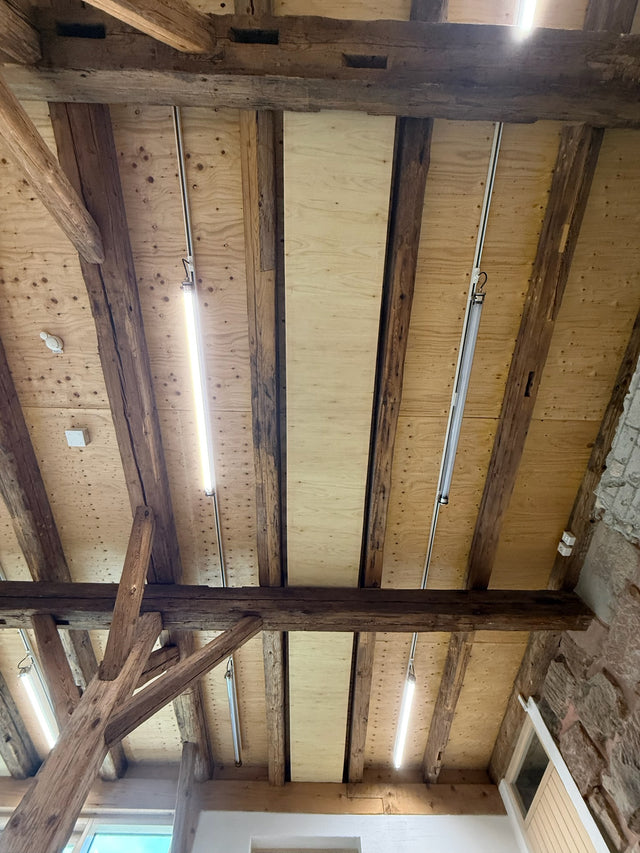
Beams, vaults, visible masonry, or valuable surfaces limit standard solutions. Customization, reversible installation, and early coordination with owners or monument protection become part of the concept.
Rented Rehearsal Room
Drilling, fire protection, dismantling, and ownership must be clarified before product selection. Mobile or demountable elements can be a better investment than a permanently glued solution.
New Construction or Major Renovation
Here, acoustics do not begin with wall color, but with room size, height, geometry, building services, and component construction. Early planning is usually more effective than correcting a finished room later.
Variable acoustics require an operational plan: A curtain or mobile element only helps if it is clear which setting is intended for which use, who will carry out the conversion, and where mobile elements will be safely stored. Without simple conditions, the theoretical flexibility is often not utilized in daily club life.
When the Existing Room Was Never Planned as a Rehearsal Room
Many music societies rehearse in rooms provided by a municipality, church community, or school. These can be former classrooms, community halls, multi-purpose rooms, or areas in older club buildings. They fulfill an important social function, but were often not structurally designed for a fully staffed brass band. This is not a failure of the society, but the real starting point that must be planned responsibly.[4]
Floor Area Alone Does Not Describe the Situation
Length and width are only one part of room geometry. Height, overall volume, parallel surfaces, niches, stage, windows, ceiling structure, furnishings, and available mounting surfaces also play a role. Ceiling heights of, for example, 2.50 to 2.80 meters are therefore not a blanket judgment of quality. However, in combination with a larger ensemble, the available room volume per person can become limited, and the ceiling can be closer to instruments and musicians. Whether 30, 50, or 60 people are rehearsing can significantly change the listening and volume situation.
Missing Volume Remains Missing Volume
Absorbers can influence reflections and reverberation. However, they do not enlarge the room, increase ceiling height, or create more distance between musicians. Good planning therefore openly states what can be improved and what limitations remain.
Not "Perfect," but Optimally Usable
In an existing building with structural limitations, a theoretical ideal is not always achievable. A more sensible approach is a comprehensible goal: reduce disturbing reflections, treat frequency ranges more evenly, improve setup, and noticeably better support rehearsals.
Especially Then, Plan Structurally From the Start
The less effective surface area, construction depth, and mounting locations are available, the more important prioritization, frequency effect, and position become. A planned phased implementation can be more sensible than many small individual measures without a common goal.
Plan with Actual Occupancy
An empty room sounds different from the same room during a rehearsal with full occupancy. Therefore, typical and maximum number of people, seating arrangement, conductor's spot, and pathways should be included in the planning. Where structural limits remain, an adapted setup or partial rehearsals can supplement acoustic measures.
DIY is not automatically unsuitable: A planned DIY project with suitable materials, comprehensible effect, sufficient construction depth, safe construction, and correct positioning can work. This is to be distinguished from random DIY solutions made of thin decorative materials, foam profiles, or leftover pieces. Especially in a small, fully occupied room, they can consume scarce mounting surfaces without adequately treating the crucial frequency ranges.
How the Quantity and Position of Absorbers Are Determined
The common question "How many absorbers does the rehearsal room need?" cannot be seriously answered with a single number. Two rooms with the same footprint can react completely differently due to varying height, ceiling, windows, furnishings, and occupancy.
For an initial reliable dimensioning, at least the following are needed:
- Room length, width, and height
- Materials and construction of ceiling, walls, floor, windows, and doors
- Size and setup of the ensemble
- Type of music and typical dynamics
- Other uses such as speech, choir, lessons, or events
- Existing installations, furnishings, technology, and available mounting surfaces
Only then can a surface and position concept be developed. A balanced distribution is particularly important: a room can already sound dull in the high frequencies but still have a long reverberation time in the lower range. Even more thin absorption would then not solve the actual problem.
Why square meters do not equal effect
Acoustically, not only the visible surface area matters, but also its frequency-dependent absorption coefficient. Simply put, the equivalent absorption area results from the component area multiplied by the absorption coefficient. One square meter of a broadband effective, sufficiently deep construction is therefore not equivalent to one square meter of thin felt, carpet, or decorative panel. Product data should indicate at which frequencies tests were conducted and under what installation conditions.
An air gap behind a porous absorber can also change its effect. This does not mean that every absorber should be mounted as far away from the wall as possible. Construction depth, safety, available area, and the desired frequency spectrum must be considered together.
Ceiling alone or include walls?
The ceiling often offers a large continuous surface and does not require floor space. However, a ceiling-only solution can still be problematic if parallel walls create strong reflections or flutter echoes. A sensible distribution results from reflection paths, room geometry, and setup – not from the desire to hide all elements as inconspicuously as possible on a single surface.
Effect remains local
A few small elements can reduce a reflection but do not automatically change the entire room. Therefore, determine beforehand whether a local improvement or a balanced room concept is the goal.
The room becomes dull
Thin, high-frequency-biased absorption can reduce brilliance while mids and bass linger too long. The result sounds damped but is not automatically clearer.
Reflection paths remain
Even sufficient total surface area helps only to a limited extent if critical wall pairs and setup zones remain untreated. Area and position must match.
Implementable in construction phases
An overall concept can prioritize certain areas first and prepare for later stages. This ensures that even a gradual investment remains acoustically coherent.
Acoustic Measurement:
When it makes sense
For small, clearly structured rooms, sound planning based on room data, photos, and usage can already provide a good foundation. A measurement is particularly useful when the room is large, geometrically complex, or multi-purpose, when low-frequency anomalies exist, or when a larger investment needs to be secured.
Measurement is a tool, not a mandatory program: The decisive factor is not whether measurement is possible, but whether the measurement result is likely to significantly change the selection, dimensioning, or positioning of the measures. If the initial situation is clear, the room is well-documented, and the approach is reversible, data-supported preliminary planning can be more economically sensible.
If a measurement offers added value for the decision, it creates a frequency-dependent starting point and enables a documented comparison.
Three technically sound approaches
Preliminary planning from room data
With clear usage, a comprehensible problem description, and well-documented surfaces, dimensions, photos, occupancy, setup, and product characteristics can be sufficient for a sound initial dimensioning.
Optimize in stages
An overall concept first prioritizes areas with high expected impact. After the first expansion phase, rehearsal practice, feedback from sections, and remaining problems are documented; further elements are only added if still needed.
Measure on site
Measurements are particularly helpful for unclear causes, pronounced bass problems, complex geometry, multi-purpose use, high investments, or when objective before-and-after verification is required.
Measurement isn't just about "how long it reverberates." The progression across multiple frequency ranges and—depending on the task—at multiple positions is relevant. Together with room construction, usage, and listening observations, this data helps to determine suitable surfaces and effective areas.
Why room acoustics isn't just about measured values
Physical quantities describe sound in a room; psychoacoustics examines how people perceive and process this sound. For musicians, therefore, not only reverberation times matter, but also perceived loudness, timbre, spatial feedback, mutual listening, and the ability to adapt one's playing style to the room. Perception and musical reaction can differ between instruments and individuals. Therefore, measured values, listening observations, and feedback from actual rehearsals should be assessed together.[9]
What a good inventory documents
Measured values require context: room condition, number and position of sound sources, microphone positions, furnishings, doors and curtains, and whether the room was empty or occupied. Without this information, a later before-and-after comparison is only of limited significance. ISO 3382-2 describes procedures for measuring reverberation time in ordinary rooms; the planning objective for music rehearsal rooms is not automatically defined by it.[3]
Measurement, calculation, and simulation serve different purposes
A measurement describes the existing room. A calculation estimates the effect of known surfaces and materials. A simulation can model geometry, reflection paths, and variations in more detail. No method replaces a clear definition of use. Especially for complex rooms, it makes sense to consider prediction and subsequent control measurement as a cohesive process.
A comprehensible results report should not only show curves but also explain observed problems, goal definition, prioritized measures, assumed product data, and remaining uncertainties. For a board of directors, this translation is crucial for being able to make comprehensible decisions about offers and construction phases.
From Problem to Sensible Solution: Five Steps
This sequence helps avoid product purchases without a clear goal definition and brings together technical, design, and financial decisions.
Define usage and goal
Document ensemble, type of music, rehearsal process, speech, and other room functions. A multi-purpose hall requires different priorities than a dedicated orchestra rehearsal room.
Assess the room
Compile dimensions, surfaces, photos, built-in elements, and available mounting surfaces. Note striking locations and frequency ranges from practical experience.
Decide on measurement needs
Check whether a measurement can relevantly change the planning or secure a major decision. Otherwise, documented preliminary planning with prepared expansion stages may suffice.
Plan effect and design
Determine absorption surface, frequency effect, and position; then coordinate colors, motifs, frames, special shapes, and possible construction phases.
Check the result
After installation, compare listening situation, rehearsal practice, and – for demanding projects – measured values. This way, adjustments remain targeted instead of random.
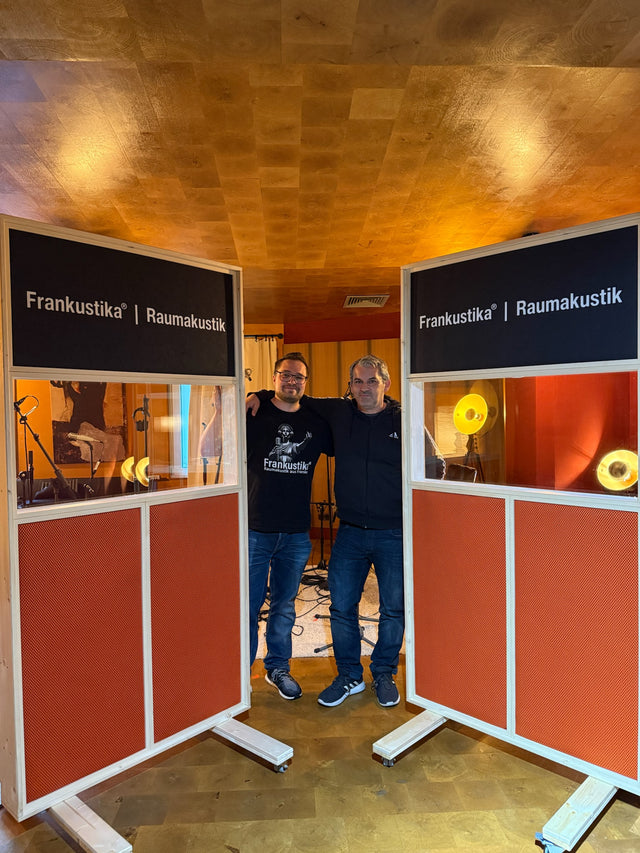
30 ANNA Absorbers for the Stadtkapelle Weißenhorn
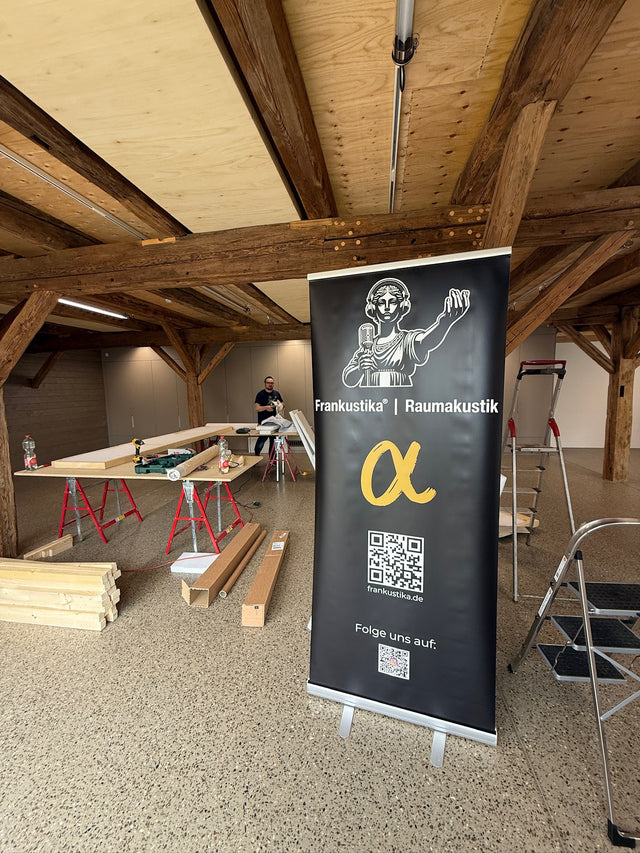
Frankustika coordinated the outfitting of the existing rehearsal room with the association during an on-site appointment. A separate acoustic measurement was not part of the order.
The association ordered 30 ANNA acoustic absorbers; Frankustika delivered them personally. In its own reel, the Stadtkapelle presents the absorbers and calls the measure an "acoustic upgrade."
Classification: A real, clearly defined practical case – not a metrological before-and-after verification.
Checklist for Board, Municipality, and Building Committee
Acoustic projects often lack comparable requirements, a clear decision-making process, or reliable information about the room. A brief project file facilitates comparable offers and comprehensible resolutions.
- Room data: Collect floor plan, sections, length, width, height, photos, and – if available – existing plans.
- Usage: Record main ensemble, maximum and minimum occupancy, rehearsal frequency, as well as speech, choir, and events.
- Problem description: Describe specific listening observations, problematic spots, technical noise disturbances, and complaints separately.
- Existing conditions: Document ceiling, walls, floor, windows, doors, curtains, furnishings, stage, ventilation, and lighting.
- Framework conditions: Clarify ownership or rental, fire protection, monument protection, accessibility, mounting surfaces, and available installation times.
- Decision goal: Determine whether consultation, a measurement, an overall concept, or already an execution offer is required.
- Comparability: For offers, have effect, area, construction, performance data, installation, ancillary work, and measurement/planning scope itemized separately.
- Success monitoring: Define in advance how results, acceptance, and possible adjustments will be professionally and organizationally reviewed.
What influences the costs?
Not just the square footage: potentially measurement, planning, absorber type, construction depth, special dimensions, printing or surface, ceiling mounting, scaffolding, electrical and ventilation adjustments, fire protection requirements, as well as travel and installation conditions all interact. A reliable cost estimate therefore requires at least room data and a defined scope of work.
How can prioritization be done?
First, areas with high expected impact and low subsequent conflicts are addressed. Later stages should already be located and structurally prepared within the overall concept. This way, a limited starting budget does not turn into a random collection of various elements.
Check funding opportunities early: In Bavaria, the Kulturfonds can, in principle, also support the construction and expansion of event and rehearsal rooms for amateur music ensembles. However, whether a specific room acoustic measure is eligible for funding depends on the overall project, the applicant, and the applicable funding conditions. The association, municipality, responsible government, and, if applicable, the music association should therefore be involved before commissioning or starting measures. Funding for a comparable project does not establish a claim for one's own rehearsal room.[6]
Typical Mistakes and Acoustic Myths
Many well-intentioned solutions only treat visible surfaces or individual frequencies. This can have little effect – or alter a room unevenly.
"Egg cartons absorb reverberation."
Egg cartons do not offer reliably planned broadband absorption. Their irregular surface can somewhat influence high frequencies, but they do not solve typical rehearsal room problems in a controlled manner. Before use in public or communal spaces, cleaning, durability, and fire protection requirements would also need to be clarified.
"Carpet and curtains are enough."
Depending on the material, grammage, folding, and air gap, textile surfaces often have a stronger effect in the mid and high frequencies than in the bass range. One-sided treatment can make the room appear damped at the top, while lower frequencies remain noticeably present.
Distributing absorbers only according to available wall space
Free space is convenient, but not automatically acoustically correct. Reflection paths, setup, and frequency response are also decisive.
Damping as much as possible
The goal is not maximum silence, but appropriate audibility. Too much or one-sided absorption can unnecessarily reduce spaciousness and musical feedback.
Rehearsal room, practice room, or rehearsal studio?
In German-speaking countries, different terms are used. In Germany, "Proberaum" (rehearsal room) is particularly common; in Austria and Switzerland, "Probenraum" (practice room), "Probelokal" (rehearsal studio), "Musikheim" (music hall), "Musikprobesaal" (music rehearsal hall), or "Vereinslokal" (club premises) are also encountered. The acoustic task remains similar: musicians should be able to hear themselves distinctly, without reflections, room modes, or technical noise dominating the rehearsal.
ISO 23591 creates a common international framework for rooms with loud acoustic, quiet acoustic, or amplified music. National standards, building codes, fire protection requirements, occupational safety, and funding conditions are added on a project-specific basis. In Austria, for example, the official planning guideline for state music schools refers to ÖNORM B 8115-3, frequency-dependent considerations, measurements, and variable solutions for multiple uses.[5]
For projects in Germany, Austria, and Switzerland, a distinction should therefore be made between the common acoustic goal and local verification requirements. A guide can help organize the questions; the binding application of norms and regulations takes place at the respective location.
Acoustic terms explained clearly
These terms often appear in measurement reports and offers. A common language facilitates coordination between the association, planning, municipality, and installation.
- Absorption coefficient α
- The proportion of incident sound energy that is not reflected back into the room under the respective test conditions; dependent on frequency and installation situation.
- Equivalent absorption area
- A calculated value that combines area and absorption coefficient. It makes surfaces with different effectiveness more comparable.
- Direct sound
- Sound that reaches the listening position directly from the instrument or voice without prior reflection.
- Diffuser
- A component or structured surface that scatters sound spatially. Scattering is not the same as absorption.
- Flutter echo
- A rapid succession of audible reflections between suitable parallel surfaces, often identifiable after clapping or short impulses.
- Frequency band
- A grouped frequency range, such as an octave band. Room responses and absorber effectiveness are assessed as frequency-dependent.
- Reverberation time RT/T
- Time-related parameter for the decay of sound. Measurements often use values extrapolated from partial ranges, such as T20 or T30.
- Room mode
- A resonance that can lead to spatially dependent amplifications or cancellations, especially at low frequencies.
- Room acoustics
- Describes the generation and propagation of sound within a room – including reflection, absorption, scattering, and listening conditions.
- Sound insulation
- Structural limitation of sound transmission between rooms or to the outside; not to be confused with sound absorption within the room.
Frequently asked questions about rehearsal room acoustics
What is the fastest way to reduce reverberation in a rehearsal room?
Effective absorption surfaces on the ceiling, walls, or both areas can help quickly. Beforehand, room dimensions, surfaces, occupancy, setup, and available space should be assessed so that the first expansion stage is applied in the right place.
How many acoustic absorbers does a rehearsal room need?
A general number of pieces would be unreliable. Room volume, existing conditions, use, frequency response, and product data are decisive. Therefore, planning is done with effective absorption area and installation locations – not solely with quantities.
Should absorbers be placed behind the orchestra or opposite?
That depends on the setup, room geometry, and reflective surfaces. Often, a coordinated combination of ceiling and several wall areas is more balanced than a completely absorbing single wall.
Can a rehearsal room be too heavily damped?
Yes. Too much or frequency-one-sided absorption can make the room dull and musically unsupportive. The goal is a balance suitable for the ensemble and the room, not the lowest possible reverberation value.
Is DIN 18041 the authoritative standard for music rehearsal rooms?
When is a professional acoustic measurement worthwhile?
Especially with complex geometry, pronounced bass problems, multi-purpose use, unclear listening situations, or a required verification. In contrast, with a clear, well-documented initial situation, data-supported preliminary planning or a first expansion stage can be useful.
Do acoustic absorbers also improve sound insulation to neighbors?
Not automatically. Absorbers primarily change reflections within the room. Sound transmission to the outside is determined by the structural design of walls, ceilings, doors, windows, joints, and flanking components and must be assessed separately.
Can the improvement be carried out in several construction phases?
Yes, if the overall concept is already established. A first stage can address prioritized ceiling or wall areas; further areas follow later. This way, the individual measures remain coordinated.
Do modern wooden slatted acoustic panels provide enough?
The complete construction is crucial: slats, open area percentage, material behind, cavity, and construction depth. Thin decorative panels are not automatically a broadband solution; tested data and the planned installation are decisive.
Are acoustic foam or pyramid foam a good solution?
Depending on the material, thickness, and installation, acoustic foam can be effective, especially in medium and high frequencies. For club rooms, low-frequency effectiveness, aging, cleaning, durability, fire protection, and optics must also be checked.
Can music clubs build absorbers themselves?
Yes, if material properties, fiber protection, construction, fastening, and fire protection are expertly implemented, and quantity and position are planned. For public or intensively used rooms, responsibility, evidence, and liability should be clarified in advance.
What to do if the rehearsal room is actually too small?
A provided room is not "bad" just because it was originally used differently. Acoustic elements can improve reflections and reverberation, but cannot create missing volume. Depending on the situation, an adapted setup, partial rehearsals, prepared expansion stages, additional rehearsal locations, or a larger room in the long term can help.[4]
How can the effect be estimated before ordering?
Through room data, product characteristics, a comprehensible area calculation and – for more complex projects – measurement or simulation. An offer should disclose the initial data and assumptions behind the recommended area; a sample only shows color and haptics.
What does it cost to optimize the acoustics of a rehearsal room?
Without room size, goal, element type, installation height, and project scope, no serious figure is possible. For an initial budget framework, dimensions, photos, use, occupancy, and problem description are usually sufficient; planning, special construction, fastening, installation, and ancillary work also affect costs.
Are there grants for acoustic measures in the rehearsal room?
Partially, but regionally very different. Programs from states, cantons, municipalities, cultural institutions, music associations, or in connection with renovation and club facilities are possible. Requirements and deadlines must be checked before commissioning. A publicly funded construction project does not automatically mean that a certain sum is reserved for acoustic products.
How is a before-and-after result documented?
Comparable measurement conditions are crucial: identical or documented source and microphone positions, room conditions, furniture, and measurement procedures. Structured feedback from several registers and from the musical director also helps. Measured values and practical observation should be assessed together.
From music practice to room planning
Frankustika combines acoustic planning, individual manufacturing, and design. Partnerships with akustika and Bavarian music associations create a direct exchange with musical practice. Details on the association program can be found on the page "Professional acoustic planning for music associations".





Have your rehearsal room assessed in a structured way
For an initial assessment, room dimensions, photos, ensemble size, use, and a brief description of the audible problems are helpful. From this, the appropriate next step can be derived – from preliminary planning to measurement and individual implementation.